|
||||
|




     |

|
|
|
TSAVORITE GARNET
|
 When you close your eyes and think of East Africa, you probably
see the brown hills of the Serengeti, the untamed herds of wildlife, the blue of the
African skies. What you probably don't imagine is the color green. But in the savannah,
some of the most brilliant green is right there--hidden underground.
When you close your eyes and think of East Africa, you probably
see the brown hills of the Serengeti, the untamed herds of wildlife, the blue of the
African skies. What you probably don't imagine is the color green. But in the savannah,
some of the most brilliant green is right there--hidden underground.
In Tanzania in 1968, a handful of brilliant green pebbles were discovered to be a totally new gemstone. It was first thought to be a strange gemological fluke. Then the lush green and brilliant grossular garnet was also discovered on the Kenya side of the border in 1971, in the Taita Taveta district.
Since this garnet was far from the dark red of bohemian garnet as most imagine, it deserved a name of its own. In 1974, the green garnet was named "Tsavorite," after the famous Tsavo National Park game preserve in Kenya by Tiffany & Co in New York, who simultaneously introduced the gemstone to the world market.
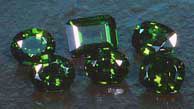
Tsavorite has a beautiful vivid green color, is bright and lively with a high refractive index, and has a garnet's durability and high clarity. Tsavorite comes from the East African bush: all the mines currently producing are in an arid grassy area with bare dry hills that runs across the border from Kenya to Tanzania. This area is home to snakes and an occasional lion.
Hundreds of millions of years ago, this land was covered by the ocean. Layers of organic sediment were deposited, eventually forming shale. Then the land was subjected to intense heat and pressure, folding and uplift, metamorphically changing the ocean floor into new minerals. This twisting and torturing of the rocks gave birth to the unusual gemstones of East Africa, many colored by the vanadium which is plentiful in these rocks because of their organic history in the ocean floor.
The geology which produces tsavorite is graphitic gneisses, rich in calcium from the seams of marble which lace through them. Tsavorite is often found in pods with a coating of quartz or scapolite, which the miners call "potatoes." The green color is most often due to vanadium from the host rock but some tsavorite is also colored by chromium, the element that greens emeralds.
The heat and folding of the rock hundreds of millions of years ago which formed tsavorite also shattered most of the crystals. It is very rare to find tsavorite in sizes larger than five carats, and most faceted stones are below two carats. Many deposits of tsavorite are small and unpredictable: seams suddenly narrow and disappear, giving no indication where to look next.
How Rare is Too Rare?
Tsavorite is cut mostly in Tanzania, Kenya and in Idar-Oberstein in Germany. Idar is known for innovative cutting and tsavorite is no exception. The cutting industry in Kenya has also started to offer fancy shapes and a larger range of sizes.
Tsavorite's rarity, as well as its beautiful green color, calls to mind the lost queen of the garnet family: demantoid garnet, discovered in Russia's Ural Mountains in 1868. Demantoid was also available mostly in small sizes. Mining of this exquisite, brilliant green garnet exhausted supply after only about 30 years and fine examples are exceptionally rare prizes for gem connoisseurs.
Perhaps the association with demantoid has hurt tsavorite: The rarity of the stone has ledjewelers around the world to treat tsavorite as a specialty item, a rare stone for collectors, not a beautiful gem to highlight in design jewelry. But better jewelers and designers have begun to explore tsavorite's potential, and some of the results are truly special.
There is potential for mining tsavorite in other areas of Kenya and Tanzania but development of new mining areas, which requires investment in machinery and high operating costs, is unlikely until demand rises. And, ironically, demand hasn't started to rise because the supply is too limited!
Eventually, the beauty of tsavorite is bound to win over a wider audience. To see tsavorite is to appreciate its appeal. The recent widening of the market for tanzanite, which came through an increase in the supply available, may convince more jewelry designers to feature this gemstone, so more people have the chance to see how deeply green a garnet can be.
|
|
|
Send E-mail to
TSN@The-Saudi.Net with questions or
comments about The Saudi Network.
We are Looking for Business Sponsorship or Marketing Partnership |